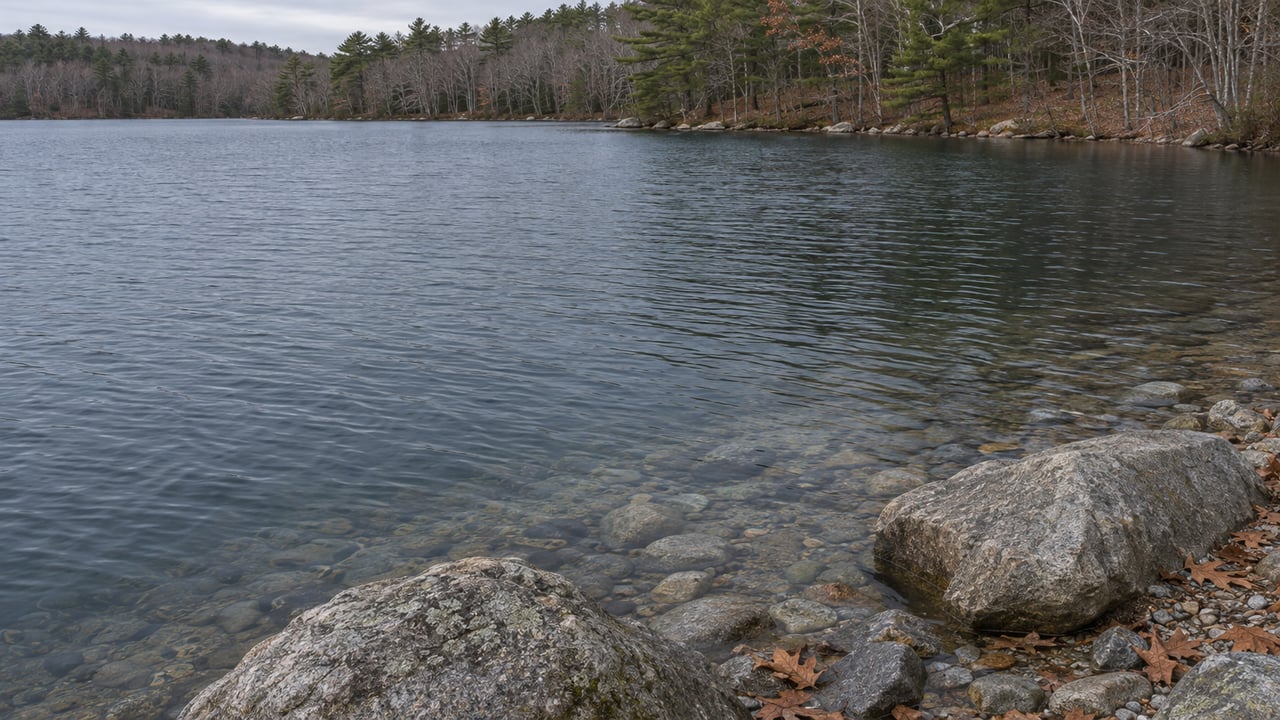
Newfound Lake had a good 2025. Water clarity improved across the lake through the season, phosphorus went down, and there were no harmful algae blooms even as reports of cyanobacteria rose around the state. By that scorecard, the lake is close to recovering from the storms of 2023.
Chloride has moved further than any other measure since the state first surveyed Newfound in 1978, and the state ties it to road salt. That puts its source in the months after the docks come out, well outside the weekly summer sampling season. For anyone who lives along North Shore Road in Hebron, the season that matters most for Newfound's long-term water starts about now.
The same people, now under a different name
If a newsletter showed up in your mailbox this fall with an unfamiliar name on it, the sender hasn't changed. On October 13, 2026, the Newfound Lake Region Association became the Newfound Conservation Alliance. It got a new logo and a new tagline, "From Source to Shore." The announcement says the mission, the work, the people and the programs all stay the same. The office is still at 178 North Shore Road in Hebron. The Union Leader ran the news on October 24 and described the new name as reflecting watershed-wide conservation work and growing partnerships.
The tagline is the important part. "From Source to Shore" describes work that runs from the forests and streams down to the shoreline and the lake. In other words, the organization now describes Newfound as the end point of everything that drains into it, and the rest of the lake's numbers make the most sense read that way.
What a good summer looks like on paper
The Alliance measures water quality every week from mid-May through September at seven long-term sites. Volunteers and university partners took more than 200 samples in 2025. Here are the season medians next to the 2024 figures, the ten-year median, and the state's high-quality standard:
| Measure | NH high-quality standard | 10-year median | 2024 median | 2025 median |
|---|---|---|---|---|
| Water clarity | more than 13.1 ft | 27.2 ft | 25.5 ft | 27.7 ft |
| Total phosphorus | under 8 ppb | 4 ppb | 3.9 ppb | 3.8 ppb |
| Chlorophyll-a | under 3.3 ppb | 1.58 ppb | 1.73 ppb | 1.61 ppb |
All three measures moved the right way between 2024 and 2025, and clarity ended up slightly better than the ten-year median. Every monitoring site recorded clarity readings it hadn't seen since 2022. Lake Hosts inspected 1,796 boats in 2025 and found no invasive aquatic plants. The summer of 2026 started the same way. In an August 2026 update, the Alliance reported that 19 Weed Watcher volunteers paddled 75 miles, surveyed the entire shoreline and found zero invasive plants.
This pattern has happened before. The Alliance's long-term record shows Tropical Storm Irene in 2011 cutting lake transparency by 80%, down to 6.9 feet, with effects that lasted at least four years. It also says storm seasons like 2023 can affect the lake for years "but generally do not alter long-term trends." Phosphorus and sediment from a storm wash in and eventually settle out, and the lake recovers.
Chloride doesn't follow that pattern.
The survey that goes back to 1978
The New Hampshire Department of Environmental Services runs a separate program called the Lake Trophic Survey. Newfound was surveyed in 1978, 1985 and 1992, then again in 2025. The 2025 report still rates it oligotrophic, the state's term for a nutrient-poor, very clear lake. Dissolved oxygen, plant abundance and chlorophyll-a all scored as having "changed little since 1978."
Three measures did change:
- Chloride went from below 3 mg/L in 1978 to an average of 13.25 mg/L in 2025, well above the statewide average of 5 mg/L.
- Specific conductivity, which measures dissolved salts in the water, rose from about 30 µS/cm in the three earlier surveys to 41.50 µS/cm. That's still just below the statewide average.
- Secchi disk transparency, the clarity reading in the state's survey, averaged 6.1 meters in 2025, compared with 11.3 meters in 1978, 11.2 in 1985 and 9.3 in 1992.
The state's survey is measured differently from the Alliance's seven-site summer medians, so the two clarity figures tell you different things. DES says conductivity and chloride are "strongly influenced by road salt application" and that both have been rising since the 1970s. The median in 2025 was 12.40 mg/L, so the average isn't being pulled up by a few unusual readings.
Why salt doesn't settle out like a storm does
Storm runoff fades from the record because sediment and phosphorus have places to go. They settle, plants and algae take them up, and the lake slowly clears. On its road salt reduction page, DES explains that chloride isn't significantly removed by chemical processes, evaporation or vegetation. It also says more than 50 New Hampshire waterbodies are already listed as impaired for chloride.
That's how a lake can have its clearest summer readings in three years and still be carrying more than four times the chloride it had in 1978. The organization saw this coming. Starting in 2022, it added winter chloride testing to track how salt affects the watershed.
What the Alliance is watching closer to home
The rename comes with a sharper focus. The Alliance's newsletter says 2026 marked 40 years of water quality monitoring on Newfound. A five-year strategic plan calls for more environmental monitoring, stronger land conservation and pollution prevention, and deeper community engagement. The monitoring now covers three areas that the old seven-site summary didn't:
- Dock tiles along the shore. About 40 shorefront property owners hang clay tiles in the water over the summer. At the end of the season the algae on each tile is scraped off, dried and weighed, then compared from site to site and year to year. The goal is to spot areas where development or runoff nearby or upstream may be changing conditions.
- Weekly plankton counts. A grant from the Davis Conservation Foundation paid for equipment to collect plankton every week and identify and count species under a microscope. Shifts in plankton can signal changes that standard water quality measurements don't pick up.
- Spiny water flea. The first documented report of this invasive zooplankton in Newfound came from an angler fishing in Pasquaney Bay on September 17, 2025. Staff sampling then found it throughout much of the lake. The Alliance is tracking both the flea and native plankton to learn how it may affect the lake's food web. It is also working with boaters and anglers to keep it from spreading to other lakes.
All three programs depend on people who live on or use the lake, either hosting a tile, taking a plankton sample or reporting something on a fishing line. That's the same approach the new name is built around.
Salt season on North Shore Road
When the Alliance's water samples come in, winter is the stretch where a homeowner's own choices show up most directly. Last December, in a post called "It's salt season," the Alliance suggested shoveling first, using salt sparingly, sweeping up what's left over, switching to sand when it's below 15°F, and asking plowing contractors to get Green SnowPro certification. Green SnowPro is the state's voluntary training and certification program for commercial and municipal winter maintenance crews. For towns, certification involves training, a salt reduction plan, rules for storing materials, and documented equipment calibration.
None of this will show up in next summer's clarity table. Clarity reflects storms and growing seasons. Chloride reflects decades of winters, and the 2025 survey is the clearest record yet of what those winters have added to Newfound.
If you own on Newfound or anywhere in its watershed, I'm glad to talk through what the Alliance's monitoring means for your shoreline, and you can start by getting your free home valuation from Juli Kelley. For more on the north shore, see the Hebron neighborhood page.