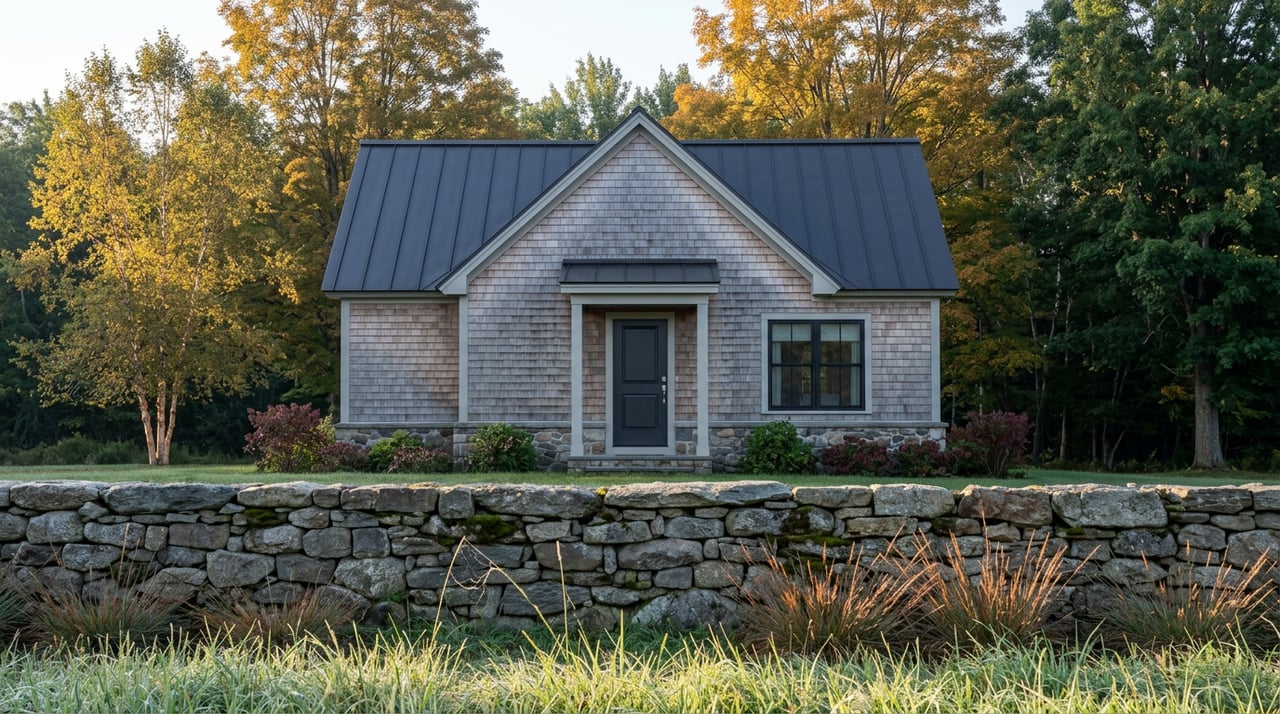
Drive Magoon Road on a Saturday morning and you'll pass the Huckins Farm store before you've had your coffee. It's been there since before anyone reading this was born, a small dairy operation with a farm stand that opens at 8 a.m. and sells raw milk, cream, and yogurt made from a herd of Guernseys who each have names instead of tag numbers. Keep driving toward Sky Pond Road and, a short while later, you're standing on a rock ledge looking down at Winona Lake with the Sandwich Range behind it. Most people who live in New Hampton have done some version of this loop without thinking much about why it still looks the way it does.
Here's the part that changes the story: the reason that drive hasn't changed and, more specifically, can't change, isn't luck, and it isn't zoning that could get rewritten at a future town meeting. It's two separate, permanent legal facts sitting side by side on the same stretch of road. One is brand new. The other has been there the whole time.
A 200-Year-Old Farm Just Got a Permanent Answer
Huckins Farm has been farmed continuously for more than two centuries, and the Huckins family has owned it since 1906. Matty Huckins took it over in 1988, arriving, by her own account, with no farming background and a love of animals. What she built is a Grade A certified micro-dairy with sixteen Guernseys on rotational pasture grazing, producing raw milk, cream, kefir, yogurt, cheddar, feta, and cheese curds sold out of the farm store on Magoon Road, open daily from 8 a.m. to 8 p.m.
What changed recently is the paperwork underneath it. The Lakes Region Conservation Trust completed an agricultural land easement on approximately 128 acres of the farm's fields and forest, its seventh farmland conservation project in the region. An easement like this doesn't change who owns the land or how it's farmed. What it removes, permanently, is the option to subdivide or develop it, regardless of who owns Huckins Farm ten or fifty years from now.
The money behind it tells you how many separate parties decided this specific piece of ground was worth locking down:
| Funding source | Contribution |
|---|---|
| NH Land and Community Heritage Investment Program (LCHIP) grant | $236,500 |
| USDA Natural Resources Conservation Service Agricultural Land Easement Program | $254,000 |
| NH Farm Future Fund, Town of New Hampton, and roughly 100 Lakes Region families and individuals | Additional support, amount not published |
Matty Huckins put it simply when the easement closed:
"The family and staff of Huckins Farm are so grateful and honored to see the support of the community."
That's not a marketing line. It's what happens when a town, a state program, a federal agriculture agency, and a hundred private donors all decide the same 128 acres shouldn't ever become house lots.
Just Up the Road, the State Already Made the Same Bet
Here's what most people driving past Huckins Farm don't clock: the land at the other end of the loop was already off the table, and has been for a while. Sky Pond State Forest sits just up the road, and unlike the farm, it never needed a conservation easement because it's already public land held by the state.
The trailhead for Bald Ledge sits at the end of the maintained section of Sky Pond Road, past a boat launch with composting toilets, where the pavement gives way to a gravel class 6 road. The hike itself is short and forgiving, a 1.6 to 1.7 mile out and back with about 100 to 180 feet of elevation gain, rated 4.6 stars across roughly 440 AllTrails reviews. Sky Pond itself is restricted to fly fishing only, which keeps the water quiet even on a busy weekend. From the ledge, the view runs down to Winona Lake directly below, out to the Sandwich Range and Ossipee Range on the horizon, and on a clear day you can pick out slices of Squam, Waukewan, and Winnipesaukee further off.
So the two ends of this loop got protected by two entirely different mechanisms, at two entirely different times, for two entirely different reasons. The state forest has been public land for decades. The farm's fields became permanently off-limits to development only recently, through a recorded easement rather than a town vote. Neither depends on the other, and neither depends on New Hampton's zoning ordinance staying the way it is today.
What This Actually Means If You Live Here
If you've assumed the rural stretch between Magoon Road and Sky Pond Road looks the way it does because nobody's gotten around to developing it yet, that assumption no longer holds for at least half of that corridor. A recorded agricultural easement is not a zoning designation that a future select board could vote to change. It runs with the land. The farm can be sold, inherited, or passed to a new operator, and the 128 acres under easement still can't be subdivided or built on.
That's a different kind of permanence than most people assume rural character carries. Plenty of open land in the Lakes Region looks protected simply because it hasn't sold yet. This particular stretch is protected.
If You're Doing the Loop This Fall
A few stops make the whole morning-to-evening version of this drive worth doing, especially with foliage starting to turn:
- Huckins Farm, Magoon Road, for raw milk, yogurt, or cheese straight from the farm store, open daily 8 a.m. to 8 p.m.
- Bald Ledge Trail, off Sky Pond Road, for the short hike and the view down to Winona Lake, best in the mid-morning before the parking at the boat launch fills in.
- Rossi's Italian Ristorante & Pizzeria, for dinner if you want a sit-down meal with a wine list.
- Route 104 Diner, a Common Man property on NH Route 104, for a full breakfast menu served all day if you'd rather flip the order and hike first.
- BBQ Shak & Smokehouse or Maple Creamery, if you want something faster or a scoop of ice cream to close out the day.
One More Thing Worth Putting on the Calendar
New Hampshire Humanities is bringing a talk called "African American Soldiers and Sailors of New Hampshire During the American Revolution" to New Hampton on Tuesday, September 22, as part of its 50th anniversary season of statewide programming. It's the kind of event that fits the town's actual character better than any generic fall listicle would suggest. A farm that's been worked for more than two centuries and a talk about the state's Revolutionary-era history make an odd but honest pair on the same September calendar. Both are reminders that a lot of what makes New Hampton feel the way it does has been sitting here far longer than any of us have been driving past it.
If you're a longtime resident who's never made the full loop, this is the season to do it. And if you've ever wondered what a property near land like this is actually worth on today's market, Juli Kelley puts together free home valuations for New Hampton owners who want a real number, not a guess. You can also browse more of what's happening around town on the New Hampton neighborhood guide.
This article is general information, not legal, tax or financial advice. Consult a qualified professional about your situation.